Was Tea Grown in Mississippi in the 1800s? The History of Tea in Brookhaven
Historical research and original article by guest contributor Jim Karegeannes. Updated and edited by The Great Mississippi Tea Company.
Was tea being grown in Mississippi during the 1800s? Yes. Historical accounts describe tea plants growing at Mikas Plantation in Lincoln County, Mississippi, during the 1880s. The experimental plantings were part of an ambitious agricultural project led by Constantine Menelas and his brother Andreas Mikas.
That's a remarkable piece of local history for us. Today, we grow and process tea in Brookhaven, Mississippi, in the same county where those early experiments took place.
While our modern tea farm has no documented connection to the original Mikas Plantation plantings, the story reminds us that the idea of growing tea in Mississippi is much older than many people realize.
Guest writer Jim Karegeannes researched this fascinating chapter of Southern agricultural history and shared the following account with us.
Who was Constantine Menelas?
Constantine Menelas arrived in Brookhaven in the 1870s with an ambitious goal: to establish a model farm that could introduce new crops and agricultural practices to Southern states recovering from the Civil War.
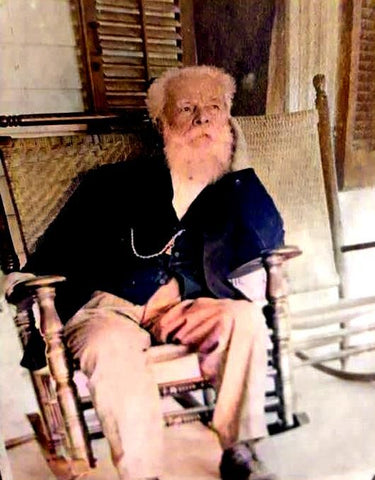
Constantine Menelas. Image source: Find a Grave.
Menelas had come to the United States several years earlier to work for a Greek cotton-trading firm in New York City. Before that, he had worked in India as a trader and Greek government envoy.
His work eventually brought him to the Cotton Exchange in Savannah, Georgia, where he promoted public gardens and horticulture. Menelas Garden, adjacent to the Cotton Exchange, was named in his honor.
As Menelas continued writing and thinking about agricultural challenges facing the Southern states, he began looking for land where he could put his ideas into practice.
Lincoln County, Mississippi, caught his attention.
Establishing Mikas Plantation in Brookhaven
Lincoln County was established in 1870 from portions of surrounding counties.
Brookhaven had developed in part through the efforts of Milton Whitworth, an early settler and plantation owner who held substantial property in the area. Whitworth played a role in bringing railroad transportation to Brookhaven, helping the town grow.

Historical marker at Dale Trail and First Street South in Brookhaven, Mississippi. Source: Mississippi Markers. Photographer to be verified.
In 1878, Menelas purchased approximately 1,600 acres of land and a plantation home from Sam Whitworth, Milton Whitworth's son.
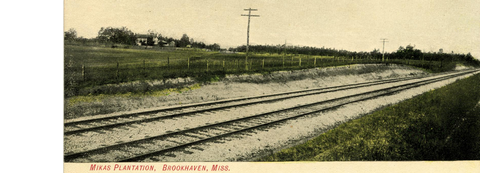
Mikas Plantation, Brookhaven, Mississippi. Image from the Mississippi Department of Archives and History, Cooper Postcard Collection.
Although Menelas continued to work and travel as a cotton trader, he made Brookhaven his home and shared the property with his brother, Andreas Mikas.

Andreas Mikas. Image source: Find a Grave. Original photographer and image rights to be verified.
Together, the brothers established a farming and livestock operation known locally as Mikas Plantation.
The property became a place for agricultural experimentation as well as an important part of Brookhaven's social life.
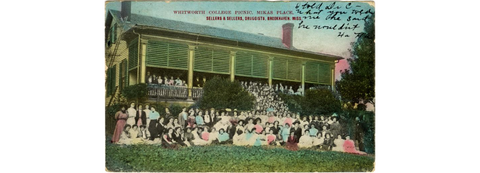
Historic postcard showing a Whitworth College picnic at Mikas Place, Brookhaven, Mississippi. Image from the Mississippi Department of Archives and History, Cooper Postcard Collection.
Tea cultivation in Lincoln County during the 1880s
The brothers experimented with an impressive range of crops.
They grew fruit trees from America, Europe, and Japan, native American grape varieties, cotton, corn, and sugarcane. They also experimented with sorghum, jute, cassava, and tea.
Tea was among the crops being tested at Mikas Plantation during the 1880s.
Historical accounts provide different estimates of the size of the tea plantings. Some visitors reported approximately 100 tea plants, while another described as much as five acres planted in tea.
These differing accounts make it difficult to establish the exact size of the operation, but they demonstrate that tea cultivation was being actively explored in Lincoln County.
Where did the tea plants come from?
The tea plants reportedly came from Robert Jones of Liberty County, Georgia, south of Savannah.
Jones was a plantation owner and editor of the agricultural journal Southern Cultivator.
His tea plants originated from Chinese tea seeds supplied by the United States Department of Agriculture before the Civil War.
Jones and, later, his daughter continued selling tea seeds and young plants through their nursery for many years after the war.
This network of seed distribution helped bring tea plants to agricultural experimenters throughout the South, including Mississippi.
Could tea become a profitable Southern crop?
Menelas published numerous reports about his agricultural experiments, including his work with tea.
He believed tea could become a profitable crop in the southern United States if growers could learn and properly apply the methods required to process the leaves.
Growing tea plants was only part of the challenge. Turning harvested leaves into a finished tea that people would want to drink required additional knowledge and skill.
That distinction remains important in tea farming today.
At our own Mississippi tea farm, we know firsthand that growing healthy tea plants and processing their leaves into black, green, oolong, or yellow tea are very different parts of the work.
Did Mikas Plantation produce tea for sale?
There are no known reports in Jim's account confirming that Menelas commercially manufactured or sold finished tea from his plants.
However, he did exhibit plants and agricultural products from the farm at expositions in New Orleans and regional agricultural events.
According to the historical research, tea from the farm was displayed as late as 1906.
That means tea was still part of the plantation's agricultural story decades after Menelas purchased the property.
What happened to Mikas Plantation?
Beyond its agricultural work, Mikas Plantation became a gathering place for Brookhaven residents.
The brothers hosted an annual reception for female students of Whitworth College, along with dances and other social gatherings.
In 1908, Menelas and Mikas donated approximately 60 acres of land to the county for the construction of an agricultural high school.
Andreas Mikas died in 1910.
Following his brother's death, Menelas gradually reduced his activities and sold the plantation in 1914. He died in 1916.
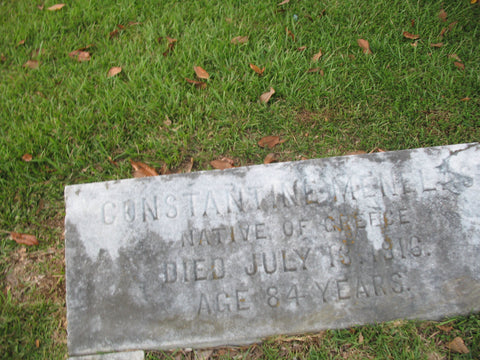
Gravestone of Constantine Menelas at Rose Hill Cemetery in Brookhaven, Mississippi. Image source: Find a Grave. Photographer to be verified.
Both brothers are buried in Rose Hill Cemetery in Brookhaven.
The plantation house reportedly burned in the 1930s, although its foundation remained. The foundation was covered during the 1950s and was reported to remain beneath the ground along Dale Trail, east of Highway 51 near the Highway 84 intersection.
Whether any of the plants established by the brothers survived is unknown.
It's an intriguing question, especially for those of us who are still growing tea in Lincoln County today.
More than a century of tea-growing history in Mississippi
The story of Constantine Menelas and Andreas Mikas gives us a different perspective on American tea.
Tea cultivation in the United States isn't an entirely new idea. Farmers and agricultural experimenters were exploring its possibilities long before today's growing interest in domestically produced tea.
What makes this history especially meaningful to us is its location.
More than a century after tea was being tested at Mikas Plantation, we're growing and processing tea commercially in the same Mississippi county.
We're proud to be part of the continuing story of American-grown tea.
About guest author Jim Karegeannes
Special thanks to Jim Karegeannes for researching and sharing this history with our readers.
At the time of the original article, Jim lived and worked in Asheville, North Carolina, where he grew and processed small quantities of tea.
He discovered the story of Constantine Menelas while researching the history of tea production in the southern United States.
His research also included preparing English-language versions of nineteenth- and early twentieth-century writings about tea production in colonial France.
You can explore his work at Brown Dog Press.
Explore more American tea history
Interested in how tea cultivation developed in the United States?
Read our related article: The History of Tea in America.
You can also explore the teas grown and processed on our Mississippi farm or learn more about visiting the farm.



Leave a comment